

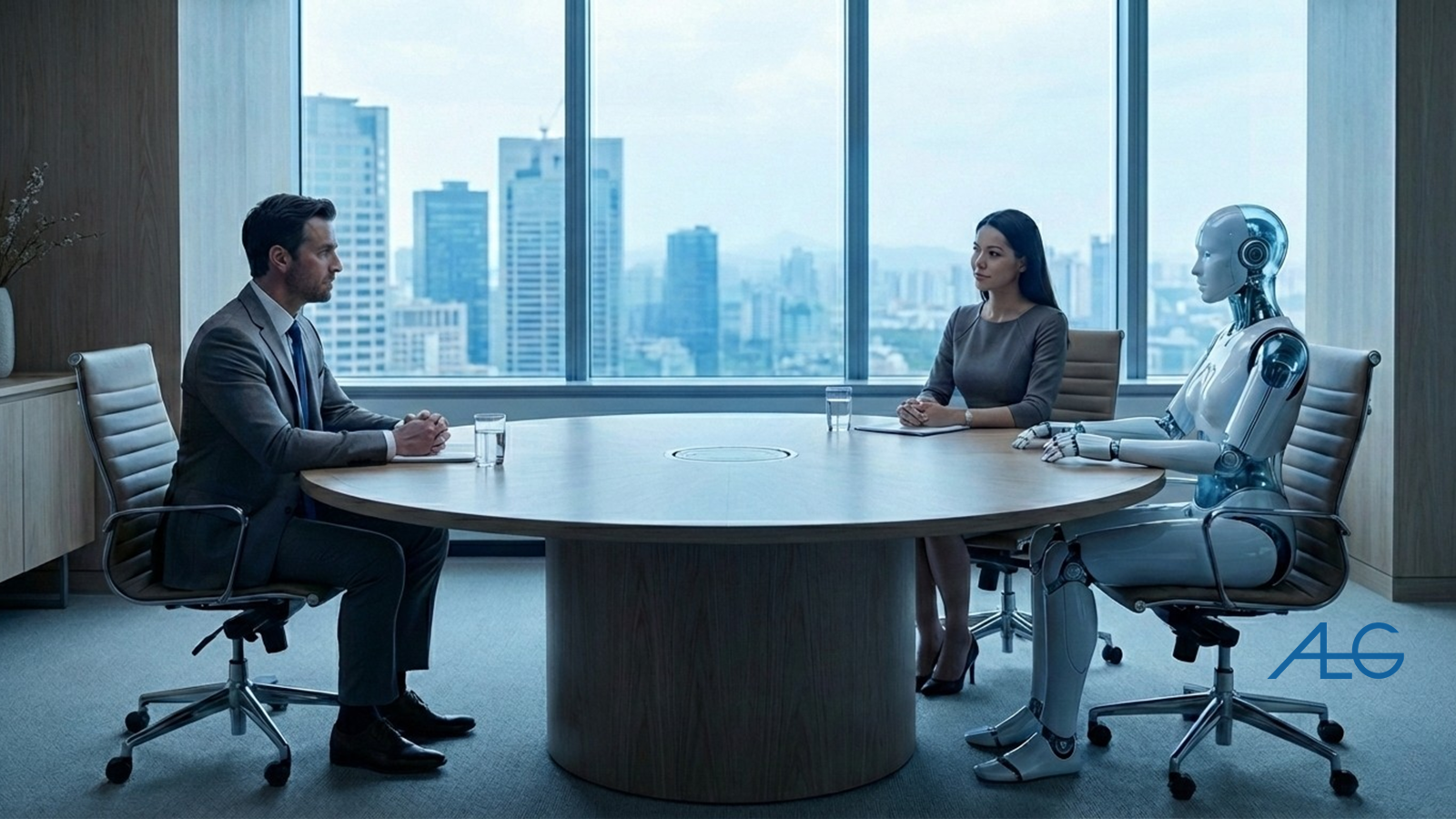
Technology is reshaping the nature of work at an unprecedented speed.
In our advisory work, we find that organizational coherence, not technological capability, is the main challenge. Competitive advantage now depends on redesigning work, decision rights, and leadership systems to ensure intelligent technologies support strategic intent.
At ALG Group Global, our Integrated Strategy Assessment (ISA) engagements consistently reveal a pattern: organizations invest in intelligent systems, but their operating models, incentives, and governance structures remain outdated. This leads to fragmentation, where pilots succeed but enterprise impact is limited.
The constraint is not technology.
It is organizational systems.
Work Is Becoming a Strategic Partnership
A fundamental shift is underway.
Work is increasingly co-produced by humans and intelligent systems operating together.
Machines provide speed, scale, pattern recognition, and optimization. Humans offer judgment, context, accountability, creativity, and ethical reasoning. Sustainable value comes from intentionally designing the partnership between these strengths, not from automation alone.
Organizations that use intelligent systems as substitutes or tactical enhancements achieve only incremental gains. Those that redesign work as a structured partnership, with clear boundaries, decision rights, and accountability, realize significant performance improvements.
This is not an IT initiative. It is a strategic design decision.
Intelligent Systems as Operating Model Capabilities
Intelligent systems are not standalone technologies.
Like electricity and computing in previous industrial shifts, intelligent systems become embedded in workflows, decision-making, and customer interactions. They influence how information flows and how decisions are made.
Within the Three-Speed Strategy System, this has important implications:
- At Speed 1 (Operate), intelligent systems increase efficiency and consistency.
- At Speed 2 (Scale), they enable faster replication and capability expansion.
- At Speed 3 (Transform), they reshape the very structure of work and competitive positioning.
Most organizations focus only on Speed 1.
Few redesign their operating model across all three speeds.
Success relies more on integrating these systems into governance, incentives, talent development, and leadership forums than on technological sophistication.
The Organizational Gap: Where Strategy Breaks
Through ISA diagnostics, we often identify a recurring misalignment:
- Technology investments outpace operating model adaptation.
- Roles remain task-defined rather than capability-defined.
- Decision rights remain centralized while intelligent systems push decisions closer to the edge.
- Incentives reward silo performance while value is created system-wide.
Global research echoes this pattern: the main barriers to scaling intelligent systems are human and structural, not technical.
The key takeaway is that organizational redesign, rather than simply deploying new tools, delivers strategic advantage.
Designing Hybrid Systems of Work
In high-performing organizations, work is not a linear sequence of human actions supported by software.
It is a coordinated system where humans and intelligent platforms co-produce outcomes.
Systems analyze data, detect patterns, optimize processes, and automate repeatable tasks. Leaders and teams interpret signals, assess trade-offs, set priorities, and apply judgment where context is critical.
Performance quality depends on the clarity of human–system interaction.
Hybrid work systems require:
- Explicit decision architecture
- Integrated workflows rather than sequential handoffs
- Clear guardrails for automation
- Transparent understanding of system strengths and limitations
This is a crucial inflection point. Many organizations now recognize that their governance frameworks must adapt to enable effective human–machine collaboration.
When Machines Lead: Governance Becomes Strategy
In functions such as pricing, fraud detection, logistics optimization, and customer segmentation, intelligent systems already operate with minimal human intervention.
This is not a future state; it is a present reality.
Within the Three-Speed framework, these domains often fall between Speed 1 and Speed 2. As automation increases, governance shifts from supervision to stewardship.
Leaders must monitor system drift, unintended consequences, ethical risks, and incentive misalignment. They must ensure that accelerating performance does not compromise long-term trust.
In the Intelligence Age, governance design is no longer administrative. It is strategic.
Human Capability as the Differentiator
While intelligent systems can amplify output, sustainable advantage depends on human capability.
People feel empowered when systems extend their reach and judgment. They disengage when reduced to exception management or excluded from meaningful decisions.
Organizations that position intelligent systems as capability multipliers, rather than cost-reduction tools, achieve stronger engagement and more consistent innovation. This shift is evident in role definitions, development pathways, and leadership forums.
Our ISA assessments frequently reveal that organizations underestimate the human dimension, which is often the difference between technical success and enterprise transformation.
Leadership in the Intelligence Age
Leadership is evolving.
In analytical domains, systems increasingly outperform individuals on specific tasks. As a result, leadership now focuses on coherence and integration: clarifying priorities, aligning portfolios across speeds, managing trade-offs, and grounding decisions in shared values.
In our Three-Speed framework, this means leaders must:
- Protect operational excellence
- Scale emerging capabilities
- Transform selectively and deliberately
All while ensuring that humans and intelligent systems operate in alignment.
This is less about mastering technology and more about orchestrating a complex, adaptive system.
The key takeaway: ethics, accountability, and purpose remain non-delegable, core human responsibilities.
The Strategic Imperative
The defining question for executive teams is not how much of the organization can be automated.
It is whether the organization is designed to operate coherently in a human–machine system.
Redesigning work, decision rights, incentives, and governance with an integrated strategic approach does more than improve efficiency. It enables organizations to become more adaptable and resilient, achieving sustained high performance across all three strategy speeds. Key takeaway: An integrated approach to organizational design supports efficiency while driving adaptability, resilience, and lasting results.
The future won’t belong to the most automated enterprises.
Organizations that integrate humans and intelligent systems, rather than keeping them as separate forces, will be best positioned to achieve their strategic goals.
